If you have spent time in the points-and-miles world, you have seen the claim: “This card earns 4X on dining.” Four points per dollar sounds generous. But four of what? Four Membership Rewards points are worth roughly four times as much as four Hilton Honors points. The multiplier tells you how many points you earn. It tells you nothing about what those points are worth when you redeem them.
To compare cards honestly, you need two numbers: the earn rate (multiplier) and the point value (cents per point). Multiply them and you get the real return on a dollar of spending. This guide is about the second number, because it is where most beginners lose money without realizing it. A card earning 5X at 0.5¢ is not beating a card earning 2X at 2.0¢ — it is losing by more than half.
We use a conservative, blended 1.5 cents per point throughout Points Brief. We will explain why below.
The valuation table 💰
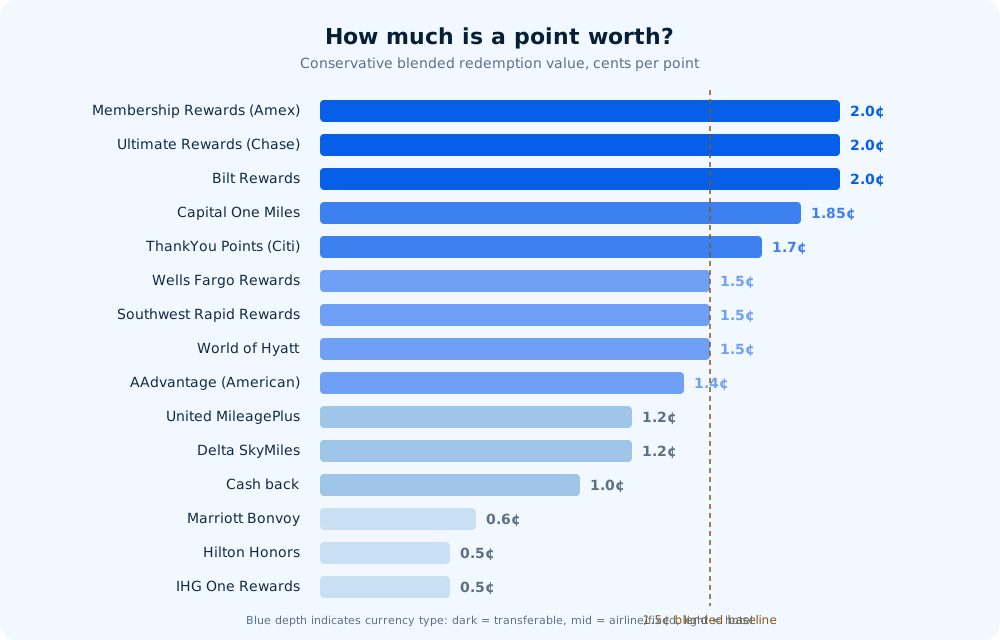
These are the point values we use at Points Brief — conservative blends, the realistic value a moderately engaged cardholder can expect across a mix of redemptions, not the ceiling a dedicated maximizer might hit on a single award booking.
| Currency | Type | Our valuation | Notes |
|---|---|---|---|
| Amex Membership Rewards | Transferable | 2.0¢ | Transfers to 20+ airline and hotel partners; strong premium-cabin value |
| Chase Ultimate Rewards | Transferable | 2.0¢ | Transfers to Hyatt, United, Southwest, and others; Hyatt is the standout |
| Capital One Miles | Transferable | 1.85¢ | Transfers to 15+ partners; also usable at fixed 1.0¢ via Purchase Eraser |
| Bilt Rewards | Transferable | 2.0¢ | Transfers to Hyatt, Alaska, United, World of Hyatt; rent earning is unique |
| Citi ThankYou Points | Transferable | 1.7¢ | Transfers to 15+ partners; slightly thinner transfer options than Amex/Chase |
| Wells Fargo Rewards | Transferable | 1.5¢ | Newer transfer program; fewer partners than the established programs |
| United MileagePlus | Airline | 1.2¢ | Strong for partner awards and premium cabins; close-in fees, no award chart |
| Delta SkyMiles | Airline | 1.2¢ | Variable pricing; value is decent on partner awards, weak on domestic economy |
| American AAdvantage | Airline | 1.4¢ | Award chart (mostly); strong for premium-cabin international awards |
| Southwest Rapid Rewards | Airline | 1.5¢ | Fixed tier-based pricing; transparent and predictable redemption value |
| World of Hyatt | Hotel | 1.5¢ | Category charts with caps; strongest hotel currency by value consistency |
| Marriott Bonvoy | Hotel | 0.6¢ | Dynamic pricing bands compress value; fifth-night-free and off-peak awards keep it above the Hilton floor |
| Hilton Honors | Hotel | 0.5¢ | Fully dynamic pricing; high point requirements, lowest-value hotel currency |
| IHG One Rewards | Hotel | 0.5¢ | Dynamic pricing with floor/ceiling caps; fourth-night-free on awards helps |
| Cash back | Fixed-value | 1.0¢ | Always exactly 1¢; the reliable floor against which other currencies are judged |
A few things stand out before we unpack the drivers. The transferable currencies cluster at the top — all between 1.5¢ and 2.0¢. The hotel currencies cluster at the bottom, with Hyatt as the notable exception. Cash back sits at exactly 1.0¢: it never goes up, and it never goes down.
What drives a currency’s value up or down 🔍
A point’s value is not arbitrary — it is set by what you can do with it. Four factors move a currency up or down the table.
Transfer flexibility
The biggest driver of value is whether a currency can transfer to multiple partners. Membership Rewards, Ultimate Rewards, Capital One Miles, Bilt Rewards, and ThankYou Points all let you move points to a menu of airlines and hotels. That flexibility is valuable because it lets you shop for the best redemption across 15 or 20 programs. When a program devalues its award chart — and they all do eventually — you transfer your points to a different partner that still has good pricing.
A non-transferable currency like United miles or Hilton points does not give you that escape valve. If United raises the price of a business-class seat to Europe, your MileagePlus miles buy less. There is nowhere else to send them.
Premium-cabin redemption value
The headline valuations on transferable currencies come from premium-cabin redemptions — business and first class on partner airlines. A one-way business-class ticket to Europe that sells for $3,500 might cost 60,000 miles transferred from Amex to a partner like Air France-KLM Flying Blue — 5.8 cents per mile. We do not use that number because most cardholders would never buy that $3,500 cash ticket in the first place, so the high fare is not a real expense the points replaced — dividing by it inflates the value. The redemption can still be worthwhile as a splurge, but the honest benchmark for most travelers is the economy fare they would actually have paid. The option to redeem for premium cabins is what supports a blended 2.0¢ valuation for Membership Rewards. The floor is lower; the ceiling is much higher.
Hotel points work the same way at the property level. A Hyatt category 7 hotel might cost 35,000 points for a $900 room — a 2.6¢ redemption. A Hilton property charging 120,000 points for the same $900 room is a 0.75¢ redemption. The currency’s blended value reflects the average of these opportunities.
Hotel category charts vs. dynamic pricing
Hotel programs split into two camps, and it is the main reason Hyatt is worth three times Hilton.
Award charts with caps (Hyatt, Marriott partially): Hyatt publishes a category chart. A category 4 hotel costs 15,000 points whether it is a Tuesday in February or a Saturday in July. When the cash price spikes during peak season, the points price does not move — so your points are worth more. This is why Hyatt’s blended value holds at 1.5¢. Marriott nominally has a chart but introduced dynamic pricing bands, compressing value at the top end.
Fully dynamic pricing (Hilton, IHG): Hilton and IHG adjust point prices to track cash prices. When the room gets expensive, the points price rises proportionally. Your points are always worth roughly the same fraction of cash — about half a cent. There is no opportunity to catch a peak-season spike and extract extra value. The fourth-night-free benefit on IHG awards (on eligible cards) helps, but the underlying value is still low.
Fixed-value vs. variable-value
Cash back and fixed-value travel credits (like Capital One’s Purchase Eraser at 1.0¢) are the simplest currencies. One point equals one cent, always. No upside, no transfer partners, no premium-cabin leverage. But no downside either — you cannot accidentally redeem cash back at a loss.
Every other currency on the table is variable-value. A Membership Rewards point redeemed for a statement credit is worth 0.6¢. The same point transferred to a partner airline and redeemed for business class is worth 5.0¢ or more. The currency’s value is a blend of how you might realistically use it, and that blend assumes you will use at least some points for higher-value transfers.
The core tradeoff: fixed-value currencies are safe and low-effort; variable-value currencies reward engagement but punish laziness. If you will not pay attention to redemptions, you are better off with a 2% cash-back card than a 4X card in a currency you will fritter away at 0.6¢.
How to use valuations: a worked example 🧮
Valuations matter because they convert multipliers into comparable returns. Here is the example that makes it click.
Suppose you spend $1,000 on dining in a month. You have two card options:
- Card A — the Amex Gold — earns 4X Membership Rewards on dining. At 2.0¢ per point, that is 4,000 points worth $80.
- Card B — the Amex Hilton Honors Surpass — earns 6X Hilton Honors on dining. At 0.5¢ per point, that is 6,000 points worth $30.
Same spend — and Card B earns more points. Card A still returns almost three times as much value — $50 more, every month. Over a year, that is $600 of difference for doing nothing more than choosing the right currency. This is why a 6X Hilton card is not automatically better than a 4X transferable card, and why comparing multipliers across currencies is meaningless without the valuation.
The same logic applies to a flat 2X cash-back card versus a 3X transferable card. Cash back at 2X is a guaranteed 4.0¢ per dollar (2 × 1.0¢). A 3X transferable card at a blended 2.0¢ is 6.0¢ per dollar — but only if you transfer and redeem at blended value. Redeem at the 0.6¢ statement-credit floor and the 3X card returns 1.8¢, less than half the cash-back card. The multiplier lied; the valuation told the truth.
The 1.5¢ blended assumption 📏
Throughout Points Brief, when we say a card “earns the equivalent of 3% back,” we are using a 1.5¢ blended valuation unless we state otherwise. Here is why.
Why 1.5¢: It is conservative. The transferable currencies we cover blend at 1.5–2.0¢, and we use the low end so our return estimates are achievable for a cardholder who transfers to partners but does not chase every peak redemption. It is simple — one number, applied consistently, makes comparisons honest. And it is defensible: a cardholder who transfers to partners and redeems for a mix of economy flights, mid-tier hotel nights, and the occasional premium-cabin award will land near 1.5¢ without unusual effort.
When to use a different number: If you redeem almost exclusively for premium-cabin international awards, your real valuation for transferable currencies is closer to 2.5–3.0¢. If you redeem mostly for statement credits or fixed-value travel, your real valuation is 1.0–1.2¢. The 1.5¢ assumption splits the difference — a planning number, not a guarantee.
What we never do: We do not use peak valuations to make a card look better than it is. A card earning 3X in a currency worth 2.0¢ is a strong 6% return. Calling it “15% back” because you could get 5¢ per point on a single aspirational redemption is dishonest marketing, and you will see it all over social media. We do not do it here.
How this plays out in my wallet
I carry the Bilt Palladium as my everyday card. It earns 2X on all purchases, and those points transfer to Hyatt, Alaska, United, and other partners at a blended value near 2.0¢. So my everyday earn rate works out to roughly 4% back in travel value — 2 points × 2.0¢.
That math only holds because I actually transfer and redeem the points at partner value. If I redeemed Bilt points for statement credit at 1.0¢, the same card would be worth just 2% back. The valuation I assign to my own points depends entirely on whether I am willing to do the redemption work. I am, so the 2.0¢ number is real for me. For a cardholder who is not, the same card is a 2% cash-back card — still fine, but half the value.
When I am working on a welcome bonus — which is most of the time — the valuation math shifts. Welcome bonuses are the highest-return spending you can do, often 5–10% equivalent returns during the spending-requirement window. I spend about $2,500 a month on non-rent purchases. I redirect about $500 of that to the bonus card, keep $2,000 on the Bilt to maintain the rent multiplier, and the rest stays on Bilt for the 2X. During a bonus period, the valuation I care about is the bonus return per dollar, not the everyday earn rate — because the bonus dwarfs it. We cover that framework in our welcome-offer spending-requirements guide.
Bottom line
A point is not a point. A Membership Rewards point is worth four times a Hilton point, and the only way to know whether a card’s multiplier is good is to multiply it by the currency’s value. The 4X vs. 6X example is the whole argument: same spend, the higher multiplier returns $30 while the lower one returns $80.
The currencies worth your attention cluster at the top of the table — the transferable programs at 1.5–2.0¢. They earn that premium because they are flexible: you can move them to whichever partner has the best redemption when you are ready to book. Hotel currencies, with the exception of Hyatt, sit at the bottom because dynamic pricing caps their value. Cash back sits at 1.0¢, doing exactly what it promises.
When you compare cards, do the multiplication. When a blogger claims a 5% return, check whether they used a peak valuation or a blended one. And when you choose a currency, be honest about whether you will do the redemption work — a transferable currency redeemed at the floor is worth less than a plain cash-back card. The valuation is only real if you use it the way the valuation assumes.
Reader feedback