Not all points are created equal. A point you earn on a flat cash-back card and a point you earn on a premium travel card look the same on your statement, but they behave very differently when it is time to spend them. The single biggest reason a travel card can be worth an annual fee — sometimes many times over — is one feature: the ability to transfer points to airline and hotel loyalty programs.
This is the mechanic that turns an ordinary rebate into outsized travel value. In this guide I walk through the three families of points, why transfers unlock value, the major transfer ecosystems, and — just as importantly — when transferring is the wrong move.
The three types of points 🧺
Every rewards currency you earn from a credit card falls into one of three buckets. Knowing which bucket your points sit in is the first step.
1. Fixed-value points. Cash-back cards (and the travel portals tied to many issuers) give you points worth a set amount — almost always 1 cent each, or up to 1.5 cents when redeemed through a bank portal. There is no way to make a fixed-value point worth more. One cent is one cent. The upside is simplicity and flexibility: you always know what you are getting.
2. Co-brand points. Cards that carry an airline or hotel name — a United card, a Marriott Bonvoy card, a Delta card — earn points that live directly in that loyalty program. These points are locked to a single program. They can be valuable, especially for status perks, but they are not flexible. You cannot move United miles to American, or Marriott points to Hyatt.
3. Transferable points. These are the points earned on flexible travel cards from the major banks: American Express Membership Rewards (MR), Chase Ultimate Rewards (UR), Capital One Venture Miles, Bilt Rewards, and Citi ThankYou Points (TYP). Transferable points sit in a bank account until you decide where to send them. You can redeem them at a fixed value — but you can also move them, usually one-to-one, into dozens of airline and hotel programs. That optionality is what makes them the most valuable currency type for a maximizer.
Why transfers unlock value 🔓
The trick is this: once your points are inside an airline or hotel program, they are priced according to that program’s award chart or award pricing — not the flat 1 to 1.5 cents the bank offers. Award pricing is set independently of cash price, which is why it can diverge so dramatically.
A hotel night that sells for $400 cash might cost 15,000 points on an award chart. A business-class flight that sells for $3,500 might cost 60,000 miles. When you transfer your bank points in at a 1:1 ratio to fund one of those redemptions, each point can be worth far more than a cent — sometimes 2, 3, or 4 cents. The bank’s fixed-value redemption caps your upside; transferring removes the cap.
The catch is that this only works if you have a redemption in mind that is genuinely better than cash. More on that below.
The major transfer ecosystems 🌐
There are five transferable-point programs worth knowing. Each has its own roster of partners, and the rosters only partially overlap — which is why experienced maximizers often hold cards across more than one ecosystem.
| Program | Issuer / card family | Airline partners | Hotel partners | Notes |
|---|---|---|---|---|
| Membership Rewards (MR) | Amex (Gold, Platinum, Green) | 17+ (Delta, Aeroplan, British Airways, Flying Blue, ANA, Singapore, Virgin Atlantic, and more) | Hilton, Marriott, Choice | Strongest airline roster; frequent transfer bonuses |
| Ultimate Rewards (UR) | Chase (Sapphire, Freedom, Ink) | 10+ (United, Southwest, British Airways, Aer Lingus, Iberia, Flying Blue, Singapore, Emirates) | Hyatt, Marriott, IHG | Best-in-class hotel partner in Hyatt |
| Capital One Miles | Capital One (Venture, Venture X) | 15+ (Aeroplan, Avianca, Virgin Atlantic, Turkish, Finnair, and more) | Wyndham, Choice (select) | Ratios vary; bonuses common |
| Bilt Rewards | Bilt (Blue, Palladium) | 10+ (Alaska, American, United, Aeroplan, British Airways, Hawaiian, Turkish, Emirates) | Hyatt | Earns points on rent with no fee |
| ThankYou Points (TYP) | Citi (Strata Premier, Strata) | 15+ (Flying Blue, Avianca, Qantas, Qatar, Singapore, Turkish, Iberia) | (Limited hotel transfer) | Strong for niche airline sweet spots |
Partner counts and availability shift over time, and a few transfers are reversible. The point is that each ecosystem opens a different door — and the most valuable partners (like Hyatt for Chase, or Aeroplan for several programs) are the reason people choose one ecosystem over another.
Transfer ratios 🔀
Most transfers happen at 1:1 — 1,000 bank points become 1,000 airline miles or hotel points. That clean ratio is what makes the math predictable. A handful of notable exceptions are worth memorizing, because they change the calculation.
| Transfer | Ratio | What it means |
|---|---|---|
| Amex MR → Hilton Honors | 1:2 | 1,000 MR = 2,000 Hilton points (Hilton points are worth less individually, so this is roughly fair) |
| Amex MR → JetBlue TrueBlue | 1:0.8 | 1,000 MR = 800 JetBlue points (a discount — transfers less attractive) |
| Chase UR → Hyatt | 1:1 | The single most consistently valuable hotel transfer |
| Chase UR → most airlines | 1:1 | United, Southwest, British Airways, Flying Blue, etc. |
| Bilt → most airlines/hotels | 1:1 | Including Hyatt and Alaska, both hard to get otherwise |
| Capital One → select partners | varies | Some 1:1 (e.g., Aeroplan, Avianca), others at reduced ratios — check before you transfer |
The reduced ratios (like Amex to JetBlue) are not automatically bad — they just mean you need a correspondingly better redemption to come out ahead. Always check the current ratio on the issuer’s transfer page before committing, because ratios do change.
Sweet-spot redemptions 🎯
A “sweet spot” is an award that delivers unusually high value per point. Here are three well-known examples that show why the transfer feature matters.
Hyatt with Chase Ultimate Rewards. This is the textbook hotel sweet spot. Chase transfers to World of Hyatt at 1:1, and Hyatt’s award chart includes Category 4 properties at 15,000 points per night. At popular urban or resort hotels, a Category 4 room can sell for $300–$400 — meaning each point is worth roughly 2 to 2.7 cents, well above the 1.5-cent blended valuation I use as a baseline.
Aeroplan with Amex MR or Bilt. Air Canada’s Aeroplan is a Star Alliance program, which means its miles book flights on dozens of partner airlines including United, Lufthansa, and ANA. It is frequently cited for long-haul premium-cabin value — business class to Europe or Asia for a fraction of the cash fare. Amex, Bilt, and Capital One all transfer to Aeroplan, making it one of the most reachable programs for a maximizer.
Flying Blue with Amex MR or Citi ThankYou. Air France–KLM’s Flying Blue runs a monthly “Promo Rewards” sale that discounts award flights on select routes, and its distance-zone pricing creates consistent sweet spots for travel to and within Europe. Both Amex and Citi transfer in at 1:1, and Flying Blue’s award space often beats what you would find booking the same flight through a US airline.
A worked example: 50,000 Chase points
Suppose you have 50,000 Chase Ultimate Rewards points. You have two basic choices.
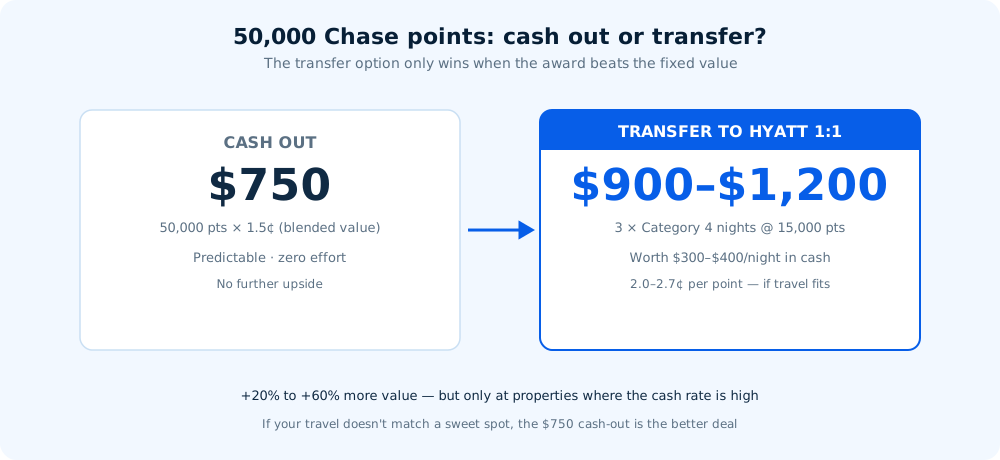
- Cash them out at the standard value and you get a flat return. At a conservative 1.5 cents per point, that is $750 in statement credit or travel-portal value. Predictable, but capped.
- Transfer to Hyatt at 1:1, giving you 50,000 World of Hyatt points. At 15,000 points per Category 4 night, that is three nights (with points left over). If each of those nights would cost $300–$400 in cash, you are looking at roughly $900–$1,200 in lodging value — meaningfully more than the $750 cash-out option.
The assumption doing the heavy lifting here is that you actually want those hotel nights at a property where the cash rate is high. If your travel doesn’t match the sweet spot, the math collapses and cash is better. Transferring only wins when you have a specific, better-than-average redemption lined up.
Transfer bonuses 🎁
Both Amex and Capital One regularly run transfer bonuses — typically 25% to 40% extra points when you move currency to a specific partner during a promotional window. A 40% bonus to an airline you already use can turn an ordinary transfer into an exceptional one, effectively lowering the cost of your next award flight.
These bonuses are time-limited and partner-specific, so they favor maximizers who are paying attention and have flexible travel plans. If you are not in a hurry, it can be worth waiting for a bonus to your preferred program before transferring. The flip side: never transfer speculatively into a program you don’t have a use for, even with a bonus. Points parked in an airline program can devalue, and bonus points you never redeem are worth zero.
When NOT to transfer 🛑
Transferring is powerful, but it is not always right. I avoid transferring in a few situations:
- No concrete redemption in sight. Once points leave your bank account, they are subject to that program’s rules and devaluations. Don’t transfer on a whim.
- The fixed-value option is already competitive. If a flight or hotel is cheap in cash, redeeming points at 1.5 cents through the portal can beat a transfer. Run the per-point math both ways.
- The transfer ratio is poor. A reduced ratio (like Amex to JetBlue) raises the bar — you need an even better redemption to justify it.
- You need flexibility. Transferred points generally cannot be moved back. If your plans might change, keep the points in the flexible bank currency until you are ready to book.
The general rule: transfer when you have a specific award that beats the fixed-value redemption, and the timing is locked in. Otherwise, hold.
The bottom line 🧭
Transferable points are the most valuable currency a credit card can earn, and the transfer feature is the reason. The ability to move points into airline and hotel programs — where award pricing can value a point at two, three, or more cents — is what separates a travel card from a glorified cash-back card.
But the optionality is only worth something if you use it well. The maximizer’s discipline is simple: know your ecosystems and their partners, watch for transfer bonuses, and only pull the trigger when you have a real redemption that beats the cash alternative. Do that, and the same points that were worth $750 as cash can become $1,000 or more in travel. Don’t do it, and you have left the single biggest source of credit-card value sitting on the table.
Reader feedback