Every time you swipe a rewards credit card, the merchant pays a fee of about 2.5 to 3.5 percent of the purchase price. That fee — called interchange — is the engine that powers the entire points-and-miles economy. The points you earn are not a gift from the bank. They are a rebate, funded by the fees merchants pay to accept your card.
If you have ever wondered why a card can afford to give you 3 points per dollar on dining, or why airlines and hotels partner with banks at all, the answer starts here. Understanding the flow of money behind every swipe is the foundation for every decision you will make about which cards to carry, which categories to optimize, and how many cards you actually need.
The swipe fee: who gets what 💳
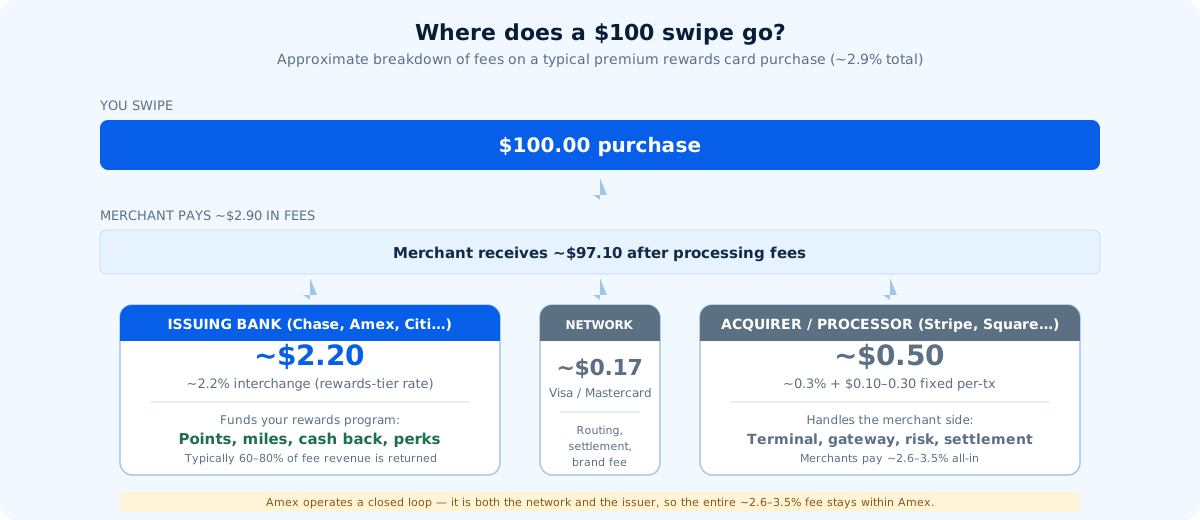
When you make a $100 purchase with a rewards credit card, the merchant does not receive $100. They receive approximately $97.10. The remaining $2.90 is split between three parties:
The issuing bank gets the largest cut
The bank that issued your card — Chase, Amex, Citi, Capital One, Wells Fargo — receives the bulk of the interchange fee, typically 1.95 to 2.4 percent of the transaction on rewards cards (higher than the ~1.3% on basic no-frills cards). This is the revenue stream that funds rewards programs.
The issuing bank uses this revenue to cover three things:
- Rewards — The points, miles, or cash back credited to your account. This is typically 60 to 80 percent of the interchange revenue on rewards cards.
- Operating costs — Fraud prevention, customer service, statement production, technology infrastructure.
- Profit — What remains after rewards and costs.
The card network gets a small slice
Visa and Mastercard do not issue cards or lend money. They operate the rails — the network that routes the transaction from the merchant to your bank and back. For this service, they charge a network fee of roughly 0.10 to 0.20 percent per transaction, plus a small fixed per-transaction charge.
Visa and Mastercard also publish the interchange schedules — the official rate tables that determine how much the issuing bank receives for each transaction type. These rates vary by merchant category, card type, and transaction method (in-person vs. online).
The acquirer / processor handles the merchant side
The company that provides the merchant’s payment terminal or online checkout — Stripe, Square, Fiserv, Worldpay — takes roughly 0.3 percent plus a fixed per-transaction fee of $0.10–0.30. The merchant typically sees this bundled into a single all-in rate of 2.6 to 3.5 percent, often described as the “merchant discount rate.”
Amex is different
Amex operates a closed loop. It is both the network and the issuer. When you use an Amex card, the entire fee — typically 2.5 to 3.5 percent — stays within Amex. This is why Amex can offer higher rewards rates on some categories: it captures more revenue per transaction than a Visa or Mastercard issuer, which has to split the fee with the network and the acquirer. It is also why some merchants decline Amex — the fee they pay is higher.
How points are priced into the rewards rate 🧮
When a card offers 3X on dining, it means you earn 3 points per dollar spent. If each point is worth roughly 1 cent (a conservative baseline), the bank is returning about 3 cents per dollar — or 3 percent — to you in rewards.
But the bank is collecting about 2.2 percent in interchange on that dining transaction. How does it afford to give back 3 percent?
The answer is that not every transaction earns at the elevated rate. The 3X rate applies only to the bonus category. On all other purchases, the card earns 1X — returning just 1 percent. The bank’s economics depend on the blend across all spending.
Consider a simplified example: a card earning 3X on dining and 1X everywhere else.
| Spending pattern | Monthly spend | Earn rate | Points earned | Bank interchange (2.2%) | Rewards cost (1¢/pt) | Bank net |
|---|---|---|---|---|---|---|
| Dining | $500 | 3X | 1,500 | $11.00 | $15.00 | −$4.00 |
| All other | $2,000 | 1X | 2,000 | $44.00 | $20.00 | +$24.00 |
| Total | $2,500 | 1.4X blended | 3,500 | $55.00 | $35.00 | +$20.00 |
On dining transactions, the bank loses money. On everything else, it profits. The blended result is positive — the bank nets about $20/month from this cardholder after paying rewards. That is the interchange economics in one table.
The bank bets on averages 🎲
Banks design rewards cards around averages. They know the following about the typical cardholder:
- Most spending is in the 1X “everything else” category, not in bonus categories.
- A significant portion of points are never redeemed (breakage), or are redeemed at suboptimal value.
- Annual fees are paid in full by most cardholders, but only a fraction extract full value from the benefits.
- Many cardholders carry a balance and pay interest, which is far more profitable for the bank than interchange.
The bank’s profitability model assumes that the average cardholder will earn at a blended rate of roughly 1.0 to 1.4 points per dollar across all spending, redeem at a modest value, and pay the annual fee without fully utilizing the benefits.
If you do better than the average — if you concentrate spending in bonus categories, redeem points at high value, and use the benefits you pay for — you shift the economics in your favor. You become less profitable for the bank. But because the bank profits from the average across millions of cardholders, it can afford to have a segment of maximizers who extract more value.
How a maximizer beats the average 📈
The average cardholder earns about 1.1 points per dollar across all spending. A points-and-miles maximizer can earn 2.5 to 4.0 points per dollar by using the right card for each category. Here is how the gap opens:
| Approach | Monthly spend | Card(s) used | Blended earn rate | Monthly points | Annual points |
|---|---|---|---|---|---|
| Average cardholder | $2,500 | One flat 1X card | 1.0X | 2,500 | 30,000 |
| One optimized card | $2,500 | One 3X dining/2X travel card | ~1.6X | 4,000 | 48,000 |
| Two-card setup | $2,500 | 3X dining + 3X grocery card | ~2.2X | 5,500 | 66,000 |
| Trifecta setup | $2,500 | 3X dining + 3X grocery + 3X travel | ~2.8X | 7,000 | 84,000 |
The trifecta cardholder earns 2.8× more points than the average cardholder on the same spending. At a conservative 1.5 cents per point, that is an additional $810 in travel value per year.
The single-card, two-card, and trifecta setups 🃏
One card: simplicity over optimization
A single rewards card is the right starting point for most people. One card means one annual fee, one set of rules, and no wallet juggling. The trade-off is that no single card offers elevated rates on every category.
Best single-card options:
| Card type | Example | Strength | Weakness |
|---|---|---|---|
| Flat-rate cash back | Citi Double Cash (2X) | Simple, strong everywhere | No category bonuses |
| Everyday bonus card | Amex Gold | 4X on dining and groceries | Weak on travel and transit |
| Travel mid-tier | Chase Sapphire Preferred | 3X on dining/travel, transferable points | Only 1X on most else |
| Rent + everyday | Bilt Palladium | 2X on everything, earns on rent | $495 fee, limited multipliers |
A single optimized card can lift your blended earn rate from 1.0X to roughly 1.6X. That is a 60 percent improvement over a flat 1X card — meaningful, but leaving value on the table in categories the card does not bonus.
Two cards: the sweet spot
Adding a second card to cover the first card’s weak categories roughly doubles your optimization. The two-card setup is where most maximizers settle — enough coverage to capture the majority of bonus-category value without the complexity of three or more cards.
Best two-card pairings:
| Setup | Card 1 | Card 2 | Coverage |
|---|---|---|---|
| Dining + Groceries | Amex Gold (4X dining/grocery) | Chase Sapphire Preferred (3X travel/dining/streaming) | Dining, grocery, travel, streaming |
| Rent + Travel | Bilt Palladium (2X all, rent) | Chase Sapphire Reserve (3X travel, 10X hotels) | Rent, everyday, travel |
| Everyday + Flat | Capital One Venture X (2X all) | Amex Gold (4X dining/grocery) | Everything at 2X+, dining/grocery at 4X |
The two-card setup typically achieves a blended earn rate of 2.0 to 2.4X. The key is choosing two cards whose bonus categories do not overlap — so every major spending category has at least one elevated rate.
Three cards: the trifecta
The trifecta is the setup most associated with serious points-and-miles maximizers. The idea is to carry three cards from the same ecosystem (all Chase, all Amex) so that points pool into a single currency and can be transferred to the same airline and hotel partners.
Example Chase trifecta:
| Card | Role | Bonus categories | Annual fee |
|---|---|---|---|
| Chase Sapphire Reserve | Travel + dining | 3X travel, 3X dining | $795 |
| Chase Freedom Unlimited | Everyday | 1.5X all, 3X dining, 5X Lyftr | $0 |
| Chase Ink Cash (business) | Bonus categories | 5X internet/phone, 5X office | $0 |
All three earn Chase Ultimate Rewards points, which pool together and can be transferred to Hyatt, United, Southwest, British Airways, and other partners.
Example Amex trifecta:
| Card | Role | Bonus categories | Annual fee |
|---|---|---|---|
| Amex Platinum | Travel + perks | 5X flights, 5X prepaid hotels | $895 |
| Amex Gold | Dining + groceries | 4X dining, 4X supermarkets | $325 |
| Amex Blue Business Plus | Everyday | 2X everywhere (up to $50K) | $0 |
All three earn Membership Rewards points, which pool and transfer to Aeroplan, Delta, Hilton, Marriott, and 15+ other partners.
The trifecta pushes the blended earn rate to 2.5–3.0X or higher, depending on spending patterns. But it also introduces real complexity: three annual fees, three sets of benefit enrollments, and the cognitive load of choosing the right card at every register.
Where I draw the line
I carry the Bilt Palladium as my everyday card — it earns 2X on all purchases and earns points on rent, which no other card does. I spend about $2,500 a month on non-rent purchases. With one card, my blended rate is a flat 2X.
When I am working on a welcome bonus (which is most of the time), the new card takes priority for its required spending period. The Bilt stays in the wallet for rent and for the spending I need to keep on it to maintain the rent multiplier — about $2,000 a month. That leaves roughly $500 of truly redirectable spend for the bonus card.
For me, the two-card setup is the realistic maximum during a bonus period. A trifecta would mean splitting my limited redirectable spend across three cards, none of which would earn enough to justify its annual fee. The optimization that matters most for my wallet is not maximizing category multipliers — it is maximizing the welcome bonus return per dollar, which we covered in our spending-requirement framework.
The bottom line 🧭
Points and miles are not magic. They are a rebate, funded by the 2.5 to 3.5 percent fee that merchants pay every time you swipe. The issuing bank keeps most of that fee, returns a portion as rewards, and profits from the spread.
The bank designs its rewards programs around average behavior — average spending patterns, average redemption value, average benefit utilization. If you understand the economics, you can systematically do better than the average. A single optimized card lifts your earn rate by 60 percent. A two-card setup nearly doubles it. A trifecta can triple it — but only if your spending volume justifies the complexity and fees.
The most important step is the first one: stop carrying a flat 1X card as your everyday card. Even a single switch to a card with category bonuses or a 2X flat rate puts you ahead of the average. Everything after that is incremental optimization — valuable, but diminishing in returns as you add complexity.
Sources for this editorial
- Nilson Report interchange data (industry standard) ↗ · checked Aug 11, 2026
Reader feedback