I am a points-and-miles maximizer. Most months, I am working on at least one welcome bonus — routing spend strategically to hit a threshold before the deadline clocks out. My everyday card is the Bilt Palladium, and I spend roughly $2,500 a month on non-rent purchases. That sounds like a comfortable pool to draw from, but after Bilt takes its share, the spend I can actually redirect to a new card is smaller than you might think.
This article is the framework I use to decide whether a welcome offer is worth pursuing — and why the biggest headline number is usually the wrong starting point.
The headline number is the wrong starting point 🚫
A 175,000-point welcome offer dominates a 60,000-mile offer on every leaderboard. But the spending requirement attached to that bonus — $12,000 in six months — can quietly cost more than the extra points are worth, especially if meeting it forces you to pull spend away from cards you already carry.
The question is not “which offer is the biggest?” It is “which offer delivers the most value per dollar of spending I would not otherwise do?”
Welcome-offer rankings sort by bonus size. That is useful for a quick scan, but it hides the one variable that determines whether an offer is actually achievable: how much you have to spend, and how fast.
Consider five current offers from popular cards:
| Card | Bonus | Required spend | Period | Return per $1 spent |
|---|---|---|---|---|
| Amex Platinum | 175,000 pts | $12,000 | 6 months | 14.6¢/$ |
| Chase Sapphire Reserve | 100,000 pts | $6,000 | 3 months | 16.7¢/$ |
| Amex Gold | 100,000 pts | $8,000 | 6 months | 12.5¢/$ |
| Chase Sapphire Preferred | 75,000 pts | $5,000 | 3 months | 15.0¢/$ |
| United Explorer | 60,000 miles | $3,000 | 3 months | 20.0¢/$ |
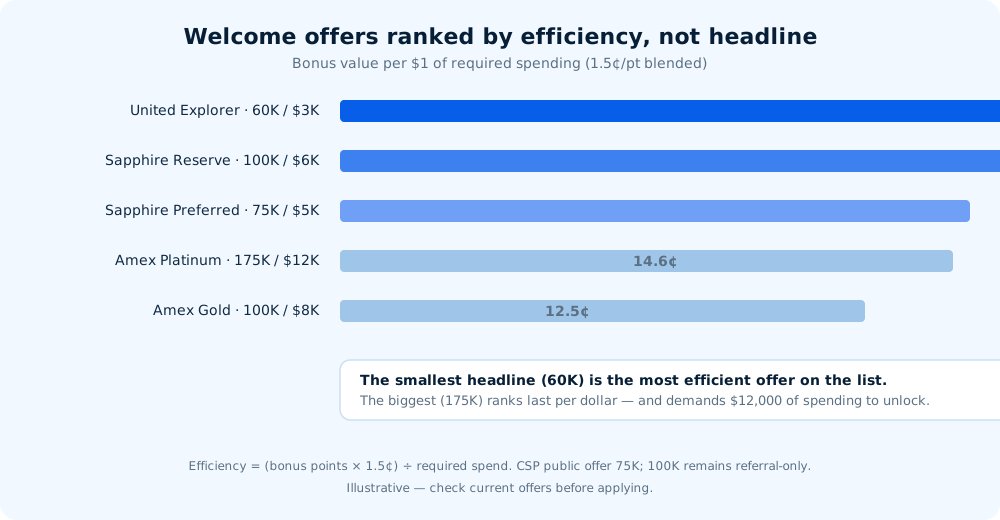
The CSP public offer recently dropped from 100K to 75K (the 100K remains available via referral links). Return-per-dollar figures use a conservative blended redemption value of 1.5 cents per point or mile — your actual value depends on the program and how you redeem.
The United Explorer’s 60,000-mile bonus is the smallest headline number on this list. It is also the most efficient offer: every dollar of required spending returns about 15¢ in bonus value at a 1.5¢/mile valuation. The Amex Platinum’s 175,000-point offer is the largest. It is also the least efficient per dollar, requiring $12,000 in spending to unlock.
This does not make the Platinum offer bad. It makes it demanding. A cardholder with $12,000 in natural, planned spending over six months should take it. A cardholder stretching to hit the threshold should not.
Three costs that make a big offer expensive 💸
A spending requirement is not free money. Each dollar you route toward a new card to hit the threshold carries opportunity cost. Three costs matter most:
Lost earning on your existing cards
Every dollar you put on the new card to hit the spend requirement is a dollar you are not putting on a card where it would have earned category bonuses. If you move $5,000 of dining and grocery spend from an Amex Gold (4× multiplier) to a new card earning 1×, you forfeit 15,000 points — worth about $225 at a conservative 1.5 cents per point — in foregone category earnings.
That $225 comes directly off the value of the welcome bonus. A 75,000-point offer that looked worth $1,125 is now worth $900.
Manufactured spending has a real price
If your natural spending falls short of the requirement, the temptation is to manufacture spending — buying gift cards, paying for services you don’t need, or prepaying bills. Each of these carries friction: activation fees, the risk of a clawback, and the mental overhead of tracking partial progress.
A $6,000 requirement that your organic spending only covers $4,000 of means you need to find $2,000 in extra transactions. If those transactions cost $40 in fees and 3 hours of effort, the net value of the bonus drops by another $60–80 when you value your time.
Time pressure changes behavior
A three-month deadline feels different from a six-month deadline. Cardholders who feel time pressure tend to shift purchases forward — buying things earlier than planned, stocking up, or choosing more expensive merchants that accept the right card. These are not fraudulent transactions, but they are spending decisions driven by the bonus rather than by need.
Research on credit-card spending behavior suggests that consumers pursuing signup bonuses tend to increase their total spending during the bonus period — whether from accelerated purchases or new ones. Each dollar of bonus-driven spending reduces the net value of the offer.
My situation: Bilt Palladium and a shrinking spend pool 🏠
I carry the Bilt Palladium and spend about $2,500 a month on non-rent purchases. That sounds like a decent pool to redirect toward a welcome offer. But Bilt changes the math in a way most welcome-offer advice ignores.
Rent earning locks up everyday spend
Bilt lets me earn points on rent — my largest monthly expense — with no transaction fee. But the rent multiplier scales with how much everyday spend I put on the card. To keep the multiplier where it needs to be, I put roughly $2,000 a month on Bilt across general everyday spending — not because Bilt has the best category rates on every purchase, but because the rent earning depends on it.
That leaves me with about $500 a month of truly redirectable spend for a new card’s welcome offer. That is enough for a $3,000/3-month requirement (United Explorer) if I concentrate every flexible dollar — but it takes the full three months. A $12,000/6-month requirement (Amex Platinum) would need $2,000/month, which is four times my redirectable pool. Meeting it would mean pulling spend off Bilt, sacrificing the rent multiplier, and still stretching.
The opportunity cost in practice
Suppose I am chasing the Amex Platinum’s 175K offer ($12,000 in 6 months). To hit $12,000 in six months, I need to redirect roughly $2,000/month to the Platinum — which means pulling most of my Bilt spend off the card. Over six months, the foregone Bilt points — on both the redirected everyday spend and the reduced rent multiplier — can be worth $120–$360.
After that opportunity cost, the Platinum’s 175K offer (worth roughly $2,625 at 1.5¢/point) has a net value closer to $2,265–$2,505. Still strong — but only achievable by gutting my Bilt earning for half a year.
Now compare with the United Explorer’s 60K offer ($3,000 in 3 months). At $500/month of redirectable spend, I need to find an extra $500/month — perhaps by shifting a recurring bill or two, or trimming my Bilt spend slightly for three months instead of six. The foregone Bilt opportunity cost is minimal — maybe $30–$60. At a 1.5¢/mile valuation, the 60,000 miles are worth about $900. After subtracting $45 of Bilt opportunity cost, the net is roughly $855 — earned in three months with far less wallet disruption.
A framework for choosing between offers 🧭
Instead of chasing the biggest headline, here is the decision sequence I use:
Step 1: Calculate your available spend
Start with your actual monthly non-rent spending. Subtract the spend you are unwilling to move (recurring bills tied to a specific card, business expenses, payments that don’t code as purchases). What remains is your redirectable pool.
If you carry a Bilt card, subtract the spend you want to keep on Bilt to maintain your rent multiplier. For me, that means putting about $2,000 a month on Bilt to keep rent earning strong, leaving roughly $500 of my $2,500 monthly non-rent spend truly redirectable.
Step 2: Compare offers by efficiency, not headline
Rank offers by return per dollar of required spending. A smaller offer you can complete with comfortable spending beats a larger offer that stretches your wallet.
| Offer | Efficiency | Best for |
|---|---|---|
| United Explorer (60K / $3K) | ~15.0¢/$ | Low-spend cardholders, Bilt users with limited redirectable spend |
| Sapphire Reserve (100K / $6K) | ~16.7¢/$ | Moderate spenders with 3-month capacity |
| Sapphire Preferred (75K / $5K) | ~15.0¢/$ | Entry-level premium, manageable threshold |
| Amex Platinum (175K / $12K) | ~14.6¢/$ | High spenders with $2K+/month of truly spare capacity |
| Amex Gold (100K / $8K) | ~12.5¢/$ | Only if dining/grocery spend naturally fits the card long-term |
Step 3: Subtract opportunity costs
If you carry a Bilt card, subtract the foregone rent-points value from each offer. For a $2,000/month renter who keeps their Bilt card active:
- Moving $3,000 of everyday spend to a new card for 3 months drops your Bilt rent multiplier temporarily, costing roughly 1,500–4,500 foregone Bilt points ($30–$90)
- Moving $12,000 of spend over 6 months costs roughly 6,000–18,000 foregone Bilt points ($120–$360)
This narrows the gap between a “big” offer and a “small” one even further.
Step 4: Check eligibility and long-term fit
Two things that do not show up in the efficiency calculation can rule out an offer entirely:
Eligibility rules. Chase’s widely-reported 5/24 rule may block approval if you have opened five or more cards in the past 24 months. Amex’s once-per-lifetime welcome offer language means you cannot get the bonus on the same card twice. As a maximizer who applies for cards regularly, 5/24 is the first filter I check before any offer — no matter how efficient it looks.
Long-term fit. A welcome offer is a one-time payment for a long-term relationship. If the card’s earning structure, credits, and benefits do not justify the annual fee in year two — without the bonus — the welcome offer is subsidizing a card you should not keep. The strongest applications are cards where the welcome offer accelerates value you were already planning to capture: a traveler who flies United anyway takes the Explorer bonus; a diner who already spends heavily on restaurants takes the Gold. The weakest are cards where the offer is the only reason to apply.
When the bigger offer actually wins 🏆
This framework does not mean you should always pick the smaller offer. The larger offer wins when three conditions hold:
-
Your natural spending covers the requirement without effort. If you spend $3,000+/month on cards anyway and the requirement fits within that, the opportunity cost is zero.
-
The card’s ongoing value justifies keeping it. A $12,000 spend requirement is fine when the card replaces a current everyday card — not when it sits alongside four others.
-
The points currency is one you can actually redeem. 175,000 Amex Membership Rewards points are extraordinarily flexible. 175,000 points locked in a hotel program you never use are worth zero.
Bottom line 🧮
The best welcome offer is not the one with the biggest number. It is the one whose spending requirement fits comfortably within your real monthly spending — after Bilt, after category bonuses on cards you already carry, and after the spending you are unwilling to redirect.
As someone who is usually working on a bonus and carries a Bilt Palladium, I have learned to respect the opportunity cost of redirected spend. A 60,000-mile offer I can complete in three months — without touching my rent multiplier — often beats a 175,000-point offer that takes six months and monopolizes my wallet. Measure the offer against your wallet, not against the leaderboard.
Sources for this editorial
- Card offer values from Points Brief card guides (verified Aug 2026) ↗ · checked Aug 11, 2026
Reader feedback