Earning points is the easy part. Every rewards card on the market will happily tell you how many points you get per dollar spent. The hard part — the part that separates a redemption worth 1 cent per point from one worth 3 cents or more — is deciding how to spend them back down.
The same 50,000 points can be worth $500 as a statement credit or $1,500 toward a business-class flight, depending entirely on the button you press. That gap is not a glitch — it is the single most important variable in the entire points-and-miles game, and it is the one the average cardholder gets wrong.
Here is the framework I use to decide whether a redemption is worth taking, and when I pay cash instead.
The four redemption tiers 🪜
Every points currency — Chase Ultimate Rewards, Amex Membership Rewards, Capital One Venture Miles, Citi ThankYou Points, Bilt Rewards — can be spent down through roughly four channels. Each channel sets a floor or ceiling on the value you can extract.
Tier 1 — Cash back or statement credit (the floor, ~1.0¢/pt)
The simplest redemption is cash back or a statement credit against a recent purchase. You apply points to erase a charge, or you deposit cash into a checking account. Each point is worth a fixed 1.0 cent — sometimes less. Some programs discount cash redemptions to 0.8¢ or 0.6¢ per point, which is a penalty, not a baseline.
This is the floor value of your points — the baseline you measure every other option against. If a travel redemption does not beat 1.0¢, you are better off taking cash and buying the trip yourself. Cash back is a respectable, zero-effort strategy on a flat 2X card. The problem arises when you hold a transferable-points card with a premium annual fee and then redeem those flexible points at the floor. You have paid for flexibility you never use.
Tier 2 — Travel portal bookings (~1.0–1.5¢/pt, the convenience tier)
Most bank programs operate a travel portal — Chase Travel, Amex Travel, Capital One Travel — where you can book flights, hotels, and rental cars using points at a fixed or boosted rate. If your card grants a redemption bonus in the portal (for example, 1.25¢ or 1.5¢ per point on the Chase Sapphire Reserve, or 1.25¢ on the Amex Platinum), this becomes the easy-value tier.
Portal bookings are convenient — you get the boosted rate without learning transfer partners or hunting for award availability. The trade-off is that you are paying the portal’s consumer cash price: no award-chart discount, no sweet spot. I use the portal for simple domestic economy flights or mid-range hotels when the boosted rate clears my 1.5¢ threshold. It is the “good enough” option, but the real upside lives in the next two tiers.
Tier 3 — Transfer to partners for economy or fixed-value awards (~1.2–2.0¢/pt, good value)
The first major step up comes when you transfer points to an airline or hotel loyalty program and book an award. This is where transferable currencies earn their annual fees. In this tier you typically see values of 1.2 to 2.0 cents per point. Common examples:
- Economy award flights on airlines with reasonable award charts (United, Air Canada Aeroplan, Air France-KLM Flying Blue), where a $300 domestic ticket might cost 15,000 miles — a 2.0¢/mi redemption.
- Hyatt fixed-value awards, where a Category 1 property costing $180/night costs 3,500–6,500 points — routinely 2.5¢/pt or better.
- Short-haul awards, like a 7,500-mile domestic award on a partner airline, where the cash fare is $120–150.
You are beating the cash price, but not dramatically. Most readers who learn to use transfer partners will spend the majority of their points here, and that is a defensible outcome.
Tier 4 — Transfer to partners for premium cabins and sweet-spot hotels (~2.0–5.0¢+/pt, maximum value)
This is the tier that draws people into the hobby. When you transfer points to an airline partner and book a business- or first-class ticket, the cents-per-point value can climb to 2.0, 3.0, or even 5.0¢ and beyond — not because the points became more valuable, but because the cash price of the premium ticket is so high that any reasonable award price looks sensational. A business-class ticket to Europe that sells for $4,000 might cost 60,000–80,000 miles through a partner program — a 5–6¢/mile redemption on paper. The same dynamic applies to Hyatt’s top categories: a Category 7 resort selling for $900/night might cost 30,000–40,000 points, a 2.2–3.0¢/pt redemption.
The catch most beginners miss: the high cents-per-point is often computed against a fare the traveler would never have paid. Most people redeeming points for business class would not buy that seat in cash at $4,000 — they would fly economy, or not take the trip. The “5¢/point” figure divides by a cash price that exists only as a list price, not as a real forgone expense. You did not save $4,000; you obtained an experience you would not otherwise have purchased. That can still be a fine use of points — if you value the lie-flat seat and it costs fewer points than the economy award alternative you would have paid for, the transfer made sense. But it is consumption, not savings, and the eye-popping ¢/pt number is largely moot as a measure of value. A more honest benchmark for a premium-cabin redemption is the economy cash fare you are actually replacing, not the premium fare nobody pays. This distinction is the source of more bad redemption decisions than any other mistake in the hobby.
Calculating cents per point 🧮
Before comparing redemptions, you need a single, consistent metric. I use cents per point (¢/pt):
¢/pt = (cash value of the redemption − taxes and fees) ÷ points used × 100
- Cash value — what the identical flight, hotel night, or product would cost in cash today: same dates, same cabin, same property. The actual bookable price, not a “list price.”
- Taxes and fees — what the award booking still charges in cash. On a $300 flight redeemed for 15,000 miles, you might still owe $11.20 in taxes. Subtract it before dividing.
- Points used — the total points cost, including any partner transfer bonuses or penalties.
Worked example — United economy: A domestic economy flight costs $311.20 cash. Redeeming 15,000 United miles covers the base fare but leaves $11.20 in taxes. Effective value: ($311.20 − $11.20) ÷ 15,000 × 100 = 2.0¢/mi.
Worked example — United business class: A business-class seat on the same route costs $1,011.20 cash. Redeeming 60,000 United miles leaves $11.20 in taxes. Effective value: ($1,011.20 − $11.20) ÷ 60,000 × 100 = 1.67¢/mi.
Notice what just happened. On paper, “business class” sounds like the premium redemption. But on a route where the business fare is only ~3.3× the economy fare and the mileage cost is 4×, the economy award actually delivers higher cents-per-point. The lesson: calculate the number. Do not assume premium cabins always win.
The same 50K points, four ways 📊
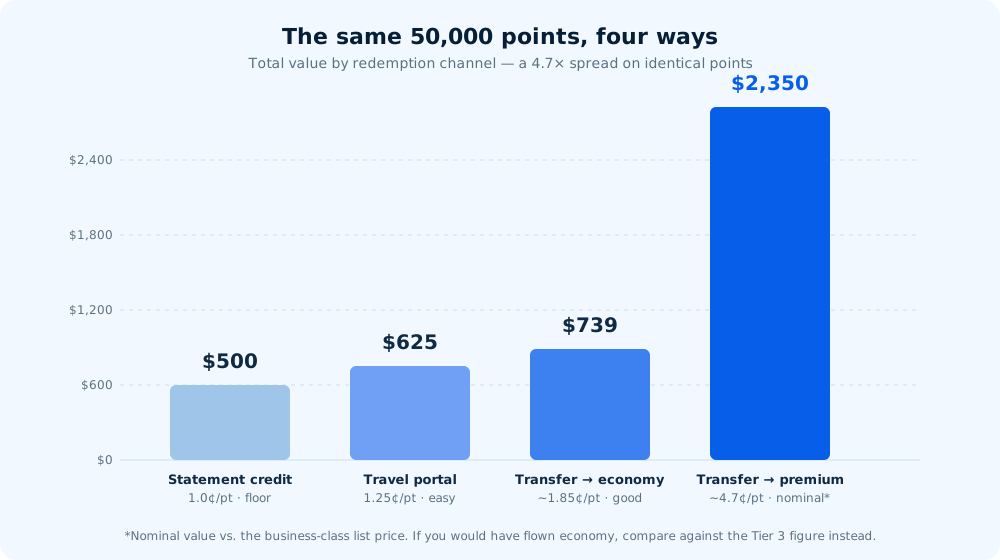
To make the tiers concrete, here is the same 50,000-point balance redeemed four ways through a transferable currency like Chase Ultimate Rewards. The figures are illustrative but representative of what I see when I search.
| Redemption | What you get | Cash equivalent | Points + fees | Value (¢/pt) | Total value |
|---|---|---|---|---|---|
| Tier 1: Statement credit | $500 erased from a recent charge | $500.00 | 50,000 pts, $0 fees | 1.00¢ | $500 |
| Tier 2: Portal booking | One domestic economy flight via portal | $625.00 | 50,000 pts @ 1.25¢, $0 fees | 1.25¢ | $625 |
| Tier 3: Transfer → economy | One economy flight via United transfer | $750.00 | 40,000 mi + $11.20 | ~1.85¢ | ~$739 |
| Tier 4: Transfer → premium | One business-class flight via partner | $2,500.00 | 50,000 mi + $150 fees | ~4.70¢ | ~$2,350 |
Read the table carefully. The same 50,000 points are worth anywhere from $500 to roughly $2,350 depending entirely on the redemption channel. That is a 4.7× spread on identical points. No earning strategy — no bonus category, no welcome offer — comes close to that multiplier. Redemption choice dominates.
A note on the Tier 4 figure: the $2,350 is the nominal value at ~4.7¢/pt. Whether it represents a real $2,350 in personal value depends on whether you would have paid $2,500 cash for that business-class seat. If you would have flown economy for $750 instead, your honest savings are closer to the Tier 3 figure. I treat the nominal cents-per-point as a ceiling, not a guarantee.
Common mistakes ❗
I have made most of these mistakes. Here are the ones I see most often:
1. Redeeming at the floor by default. The default button in most bank apps is the statement credit at 1.0¢. It is frictionless, which is exactly why it is the default. If you hold a transferable-points card with an annual fee, redeeming at the floor means you paid for flexibility you never used. At minimum, route those points through the travel portal at the boosted rate first.
2. Ignoring transfer partners entirely. Many cardholders never transfer a single point — the portal is as far as they go. If that is you, you are leaving roughly 30–60 percent of your points’ potential value on the table, because the best redemptions almost always require a transfer. Learning to transfer is the single highest-leverage skill in this hobby.
3. Overpaying for premium cabins. The flip side of ignoring transfers is fetishizing them. As the United example above shows, a premium cabin can deliver lower cents-per-point than economy on the same route if the cash premium is modest relative to the mileage premium. Always run the calculation. A 1.4¢/pt business-class redemption is not automatically better than a 2.0¢/pt economy redemption just because it says “business.”
4. Checking only one program. Transferable currencies partner with multiple airlines and hotels. Before booking, I check at least two or three partner programs for the same trip. The same night might price at 8,000 Hyatt points or 20,000 Marriott points — a 2.5× difference for an identical stay. The first program you search is rarely the best price.
5. Redeeming points to cover a cheap charge. A $4 coffee erased for 400 points is fine math (1.0¢) but bad strategy. Small redemptions fragment your balance and prevent you from accumulating enough points for a Tier 3 or Tier 4 redemption later. I hold points in a single balance until I have a redemption that clears my threshold.
When to pay cash instead 💵
This is the rule I use:
I value my points conservatively at 1.5¢ each. When I find a redemption above 2¢, I take it. Below 1.2¢, I pay cash instead.
Points are not free money — they cost spending or an annual fee to earn, and they can be devalued at any time. I would rather hold a point for a future 2.5¢ redemption than spend it today at 1.1¢. The opportunity cost of a premature redemption is the higher-value redemption I can no longer afford.
Concretely, here is how I apply the rule:
| Redemption value | My action | Reasoning |
|---|---|---|
| Below 1.2¢/pt | Pay cash | Not beating my 1.5¢ baseline by enough to justify spending the points. |
| 1.2–2.0¢/pt | Consider redeeming | Good value, especially if I have a specific use and a replenishing balance. |
| Above 2.0¢/pt | Redeem if I want the trip | Clears my threshold comfortably. I do not pass these up to “save” points for a hypothetical better deal. |
| Above 3.0¢/pt | Almost always redeem | These are rare enough that waiting for “better” is usually a mistake. |
The 1.5¢ baseline is conservative; many travelers use 2.0¢. The exact number matters less than having one and applying it consistently. Pick a threshold before you search, not after — otherwise you will rationalize whatever the search returns.
Bottom line 🧭
Redemption is where the points game is won or lost. A cardholder who earns brilliantly and redeems at the 1.0¢ floor extracts half the value of one who earns averagely and redeems at 2.0¢. No earning optimization can close a 2× redemption gap.
The framework is four tiers, one formula, and one personal threshold: cash back (floor), portal bookings (convenience), transfer-to-partner economy/fixed value (good), and transfer-to-partner premium cabins and sweet-spot hotels (maximum) — measured by (cash value − taxes/fees) ÷ points × 100, judged against a threshold you set before you search.
The single most valuable habit is the one the average cardholder never forms: transfer points to partners before booking travel. That one step moves you from Tier 2 to Tier 3 or 4, and it is where most of the unrealized value in your points balance is hiding.
Reader feedback